The Freckled Historian
Exploring history, near and far, one document at a time.
Mini History Museum
A Letter for Mary Ingalls: Education and Disability on the Dakota Frontier
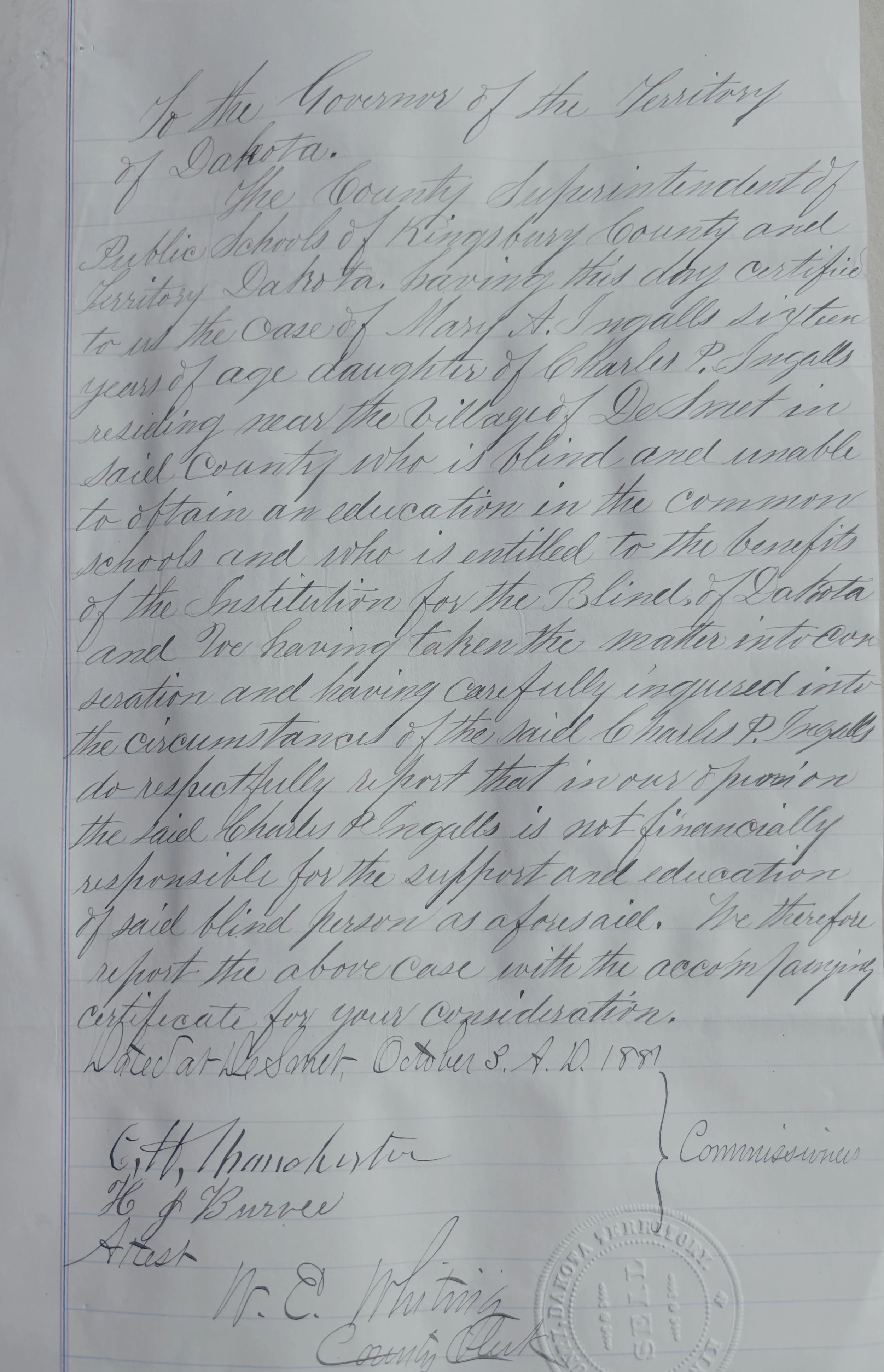
Some letters connect Dakota’s territorial history to familiar faces. When Mary Ingalls lost her sight in 1879, opportunities for education for blind Americans were expanding. Throughout the nineteenth century, state-funded institutions emerged across the country, teaching blind students to read, write, and develop skills that fostered greater independence. But for families living in remote frontier communities like Dakota Territory, accessing these schools remained a challenge.
In 1881, De Smet attorney Visscher V. Barnes wrote to territorial officials seeking assistance for Mary, then sixteen, whose family could not afford specialized education. Under a territorial law providing for blind students to attend institutions in neighboring states, Governor Nehemiah G. Ordway approved Mary's eligibility for five years of schooling at the Iowa College for the Blind. She enrolled that November and ultimately attended for seven years.
Territorial laws and government assistance could expand opportunities for people with disabilities, even in a sparsely populated frontier. After 1889, however, South Dakota discontinued this territorial funding arrangement, and Mary could no longer secure state support when she sought to return to school in 1892.
Through letters like these, the Dakota Territory Papers Project reveals how ordinary residents and their advocates turned to government for assistance and how public policy shaped their everyday lives.
Explore the digital exhibits below to discover documents, stories, and histories from one of the most transformative eras in American history, the Civil War and Reconstruction. Through records from two geographically distinct but historically connected places—Dakota Territory (1861–1889) and Mississippi (1859–1882)—explore how this pivotal period shaped communities, democracy, and the nation.